
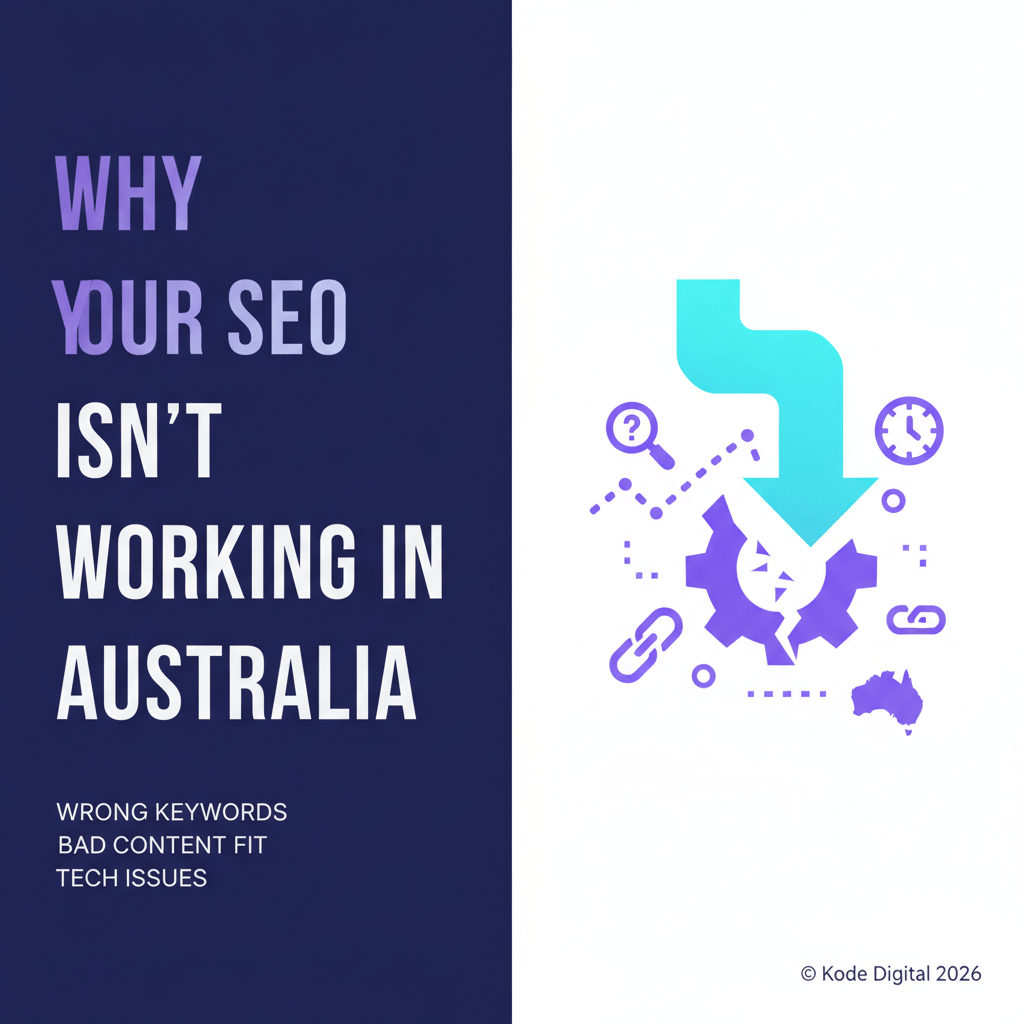
You’ve been publishing blog posts. You’ve ticked off the technical checklist. Maybe you’ve even paid for a monthly SEO retainer for the better part of a year. And yet — nothing. Your rankings are flat, organic traffic is trickling in, and the leads that do arrive don’t convert. Sound familiar?
This isn’t a niche problem. Across Sydney, Melbourne, Brisbane, and Perth, thousands of Australian small and mid-sized businesses are quietly bleeding budget on SEO strategies that look correct on paper but fail completely in practice. The frustrating part? Most of them don’t know where the breakdown is happening.
Let’s get into what’s actually going wrong — and why fixing it requires a more honest conversation than most agencies are willing to have.
Contents
You’re Ranking for Keywords Nobody Is Searching
The single most common reason SEO doesn’t produce results for Australian businesses is deceptively simple: the wrong keywords. Not bad keywords in a technical sense — wrong keywords for your specific audience, offer, and geography.
There’s a meaningful difference between ranking for a broad term like “plumbing services” and ranking for “emergency plumber Brisbane Northside.” The first might theoretically attract thousands of monthly searches across multiple countries. The second attracts people in your service area who are ready to call right now.
Keyword strategy that ignores local intent, purchase readiness, and Australian search behaviour will generate vanity metrics. Traffic numbers that look good in a report but don’t translate into enquiries, bookings, or revenue.
What to look for instead
- Transactional intent keywords: Terms that indicate the searcher is ready to act — “buy,” “hire,” “near me,” “cost,” “quote.”
- Location-qualified terms: Suburb-level and city-level modifiers that filter out irrelevant traffic from other states or countries.
- Long-tail variations: More specific phrases with lower search volume but dramatically higher conversion rates because they match exactly what someone needs.
If your SEO reporting celebrates broad keyword rankings without showing you the conversion behaviour tied to those rankings, you’re measuring the wrong thing.
Your Content Is Answering Questions Your Customers Aren’t Asking
This one cuts deep because it’s where a lot of well-intentioned effort gets wasted. Businesses publish consistently — articles, guides, FAQs — but they’re writing for search engines as they existed five years ago, not for how Australian consumers actually search now.
Google’s algorithm has shifted dramatically toward understanding why someone is searching, not just what they typed. Two searches that look similar on the surface can carry completely different intent. “Accounting software” and “best accounting software for sole traders in Australia” are targeting entirely different people at entirely different stages of a decision.
Content that doesn’t match search intent — even technically well-optimised content — will struggle to rank and will bounce visitors immediately when it does. That bounce signal then feeds back into your rankings negatively. It’s a quiet cycle that kills organic growth slowly.
The AI dimension worth understanding
This is where things have changed significantly. Businesses exploring an AI SEO service today will find that machine learning tools can now analyse search intent patterns at scale, identify content gaps across competitor sites, and flag exactly where your existing pages are misaligned with what Google expects to see. That’s not a replacement for strategy — it’s a diagnostic capability that used to take weeks of manual audit work and now takes hours.
The risk, though, is treating AI-generated content as a volume play. Publishing dozens of thin AI-written articles without editorial quality control will actively damage your domain’s authority. The businesses winning with AI-assisted SEO are using it to work smarter on fewer, more comprehensive pieces — not to flood Google with filler.
Your Technical Foundation Is Quietly Working Against You
Technical SEO isn’t glamorous, but it’s the infrastructure everything else sits on. A site with slow load times, broken internal links, duplicate content issues, or poor mobile performance will underperform regardless of how good the content strategy is.
Australian businesses running on older website platforms, shared hosting environments, or websites built without SEO architecture in mind are particularly exposed here. With NBN connectivity speeds varying significantly across regions, page speed optimisation isn’t a luxury — it’s a competitive necessity, especially for businesses serving customers in regional areas where mobile connections dominate.
The technical issues most often missed
- Core Web Vitals failures: Google measures how fast pages load, how stable elements are as a page loads, and how quickly a page becomes interactive. Poor scores here directly affect ranking position.
- Crawl budget waste: If Google is spending its crawl allocation on low-value pages — old tags, filtered URLs, parameter variations — your important pages get crawled less frequently.
- Thin or duplicate content: Service pages that are near-identical across location variants, or product descriptions copied from supplier feeds, dilute your site’s authority signal.
- Missing or misconfigured structured data: Schema markup helps Google understand your content contextually. Without it, you’re leaving visibility on the table — particularly for local search results.
You’re Waiting for SEO to Work on a Timeline It Was Never Going to Meet
There’s a genuine expectation problem in the Australian market around SEO timelines, and it causes businesses to abandon strategies that were actually starting to gain traction.
Organic search is not a paid channel. It doesn’t switch on when you fund it and off when you don’t. Building authority, earning links, and establishing topical relevance in Google’s index is a compounding process — one that typically takes three to six months to show meaningful movement for competitive terms, and longer in high-competition sectors like legal, finance, or real estate in Sydney or Melbourne.
Businesses that engage SEO services Australia-wide often encounter this: month three results look disappointing against month one expectations, the retainer gets cancelled, and then the compounding work that was quietly building gets unwound. They restart later from scratch and repeat the cycle.
The businesses that get SEO right treat it as an asset-building activity, not a monthly expense. They measure leading indicators — crawl coverage, indexed pages, keyword movement, backlink velocity — not just final rankings. And they stay the course long enough for Google to trust what they’ve built.
What It Actually Takes to Get SEO Working in a Competitive Australian Market
Straightforward answer: alignment across four pillars simultaneously — the right keywords, content that genuinely serves search intent, a technically sound website, and enough patience for the compounding to kick in.
The businesses seeing real organic growth right now aren’t necessarily spending more. They’re being more deliberate. A Melbourne trade business targeting ten highly specific, suburb-level service pages will outperform a competitor with two hundred generic blog posts and no local structure. A Gold Coast retailer with clean technical architecture and thirty well-researched product guide articles will outrank a site with five hundred thin pages.
Working with a capable SEO agency Australia businesses trust should mean getting honest diagnostics before any content or link-building starts. What’s indexed, what’s ranking, what’s broken, what the competitive landscape actually looks like for your specific terms — that groundwork determines everything.
If you’re investing in SEO services and not seeing progress, the answer is rarely “do more of the same.” It’s almost always a signal to look harder at what’s already there — and fix the foundation before building anything on top of it.
Disclaimer: SEO outcomes vary based on industry, competition, and market conditions. The information in this article is general in nature and does not constitute professional digital marketing advice.
