
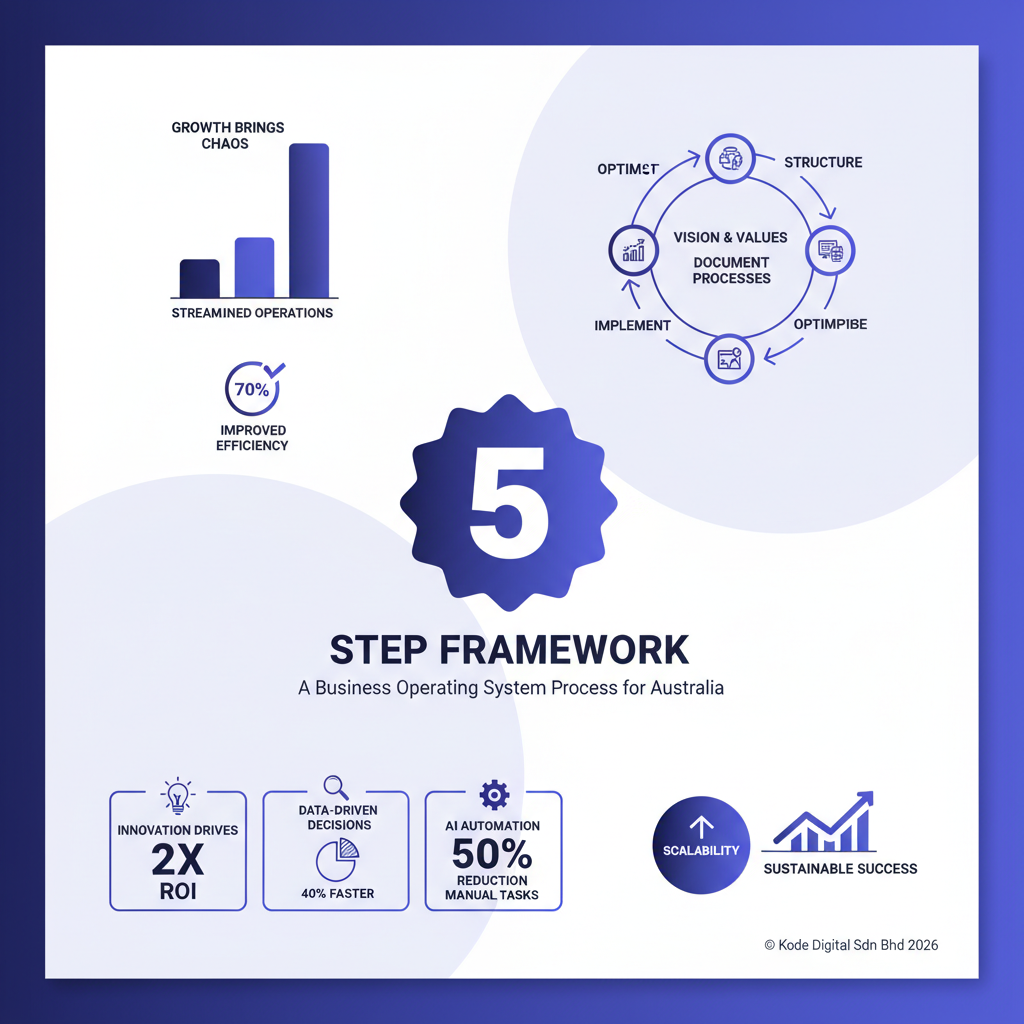
Many Australian businesses, from thriving cafes in Melbourne to innovative tech start-ups in Brisbane, face a common challenge: growth often brings chaos. What started as an agile, lean operation can quickly become entangled in repetitive tasks, unclear responsibilities, and inconsistent outcomes, turning potential opportunities into missed deadlines and burnt-out teams. This isn’t just frustrating; it’s a direct barrier to sustainable success and often impacts the bottom line.
Contents
Step 1 — Define Your Vision & Values
Before you can build an effective Business Operating System (BOS), you need a clear compass. This isn’t just a mission statement; it’s a foundational understanding of where your business is heading and the core principles that guide every decision and interaction. For Australian businesses, this means looking beyond the immediate quarter and asking tough questions about long-term sustainability, community impact, and the kind of workplace you want to foster.
Start by clearly articulating your company’s Vision: where do you want to be in 5, 10, or even 20 years? Is it to be the leading `digital marketing agency australia` for SMEs, or a beloved local brand across the Gold Coast? This vision should be ambitious, inspiring, and easily understood by everyone from your leadership team to your newest hire.
Next, define your Core Values. These are the non-negotiable behaviours and beliefs that underpin your organisation. Think about what truly matters to your business and how these values manifest daily. For instance, if ‘Integrity’ is a value, what does that mean in practice when dealing with customers or the ATO? If ‘Innovation’ is key, how do you encourage new ideas and experimentation?
Practical Tip: Involve your team in this process. While leadership sets the ultimate direction, engaging employees helps foster buy-in and ensures the values resonate authentically throughout your Aussie workplace culture. Once defined, make these visible – on your website, in meeting rooms, and through internal communications. They become the bedrock for all subsequent steps in your BOS, ensuring every process aligns with your ultimate purpose.
Step 2 — Document Your Core Processes
Once your vision and values are clear, the next critical step is to map out how your business actually operates. This means identifying, documenting, and optimising your core processes. For many Australian SMEs, processes often exist in people’s heads, leading to inconsistencies, bottlenecks, and a heavy reliance on tribal knowledge. This might work when you’re a small team, but as you scale, it becomes a significant liability, especially when onboarding new staff or handling increased demand in cities like Sydney or Perth.
Begin by identifying the 5-7 most critical processes that drive your business. These typically fall into categories like:
- Marketing & Sales: How do leads come in? How are they qualified? What’s your sales pipeline from initial contact to conversion?
- Operations/Service Delivery: What’s the step-by-step process for delivering your product or service? For a `web design australia` firm, this might include client brief, design, development, testing, and launch.
- Finance: How are invoices issued? Expenses approved? Payroll managed?
- HR: What’s the onboarding process? How are performance reviews conducted?
- Administration: How are enquiries handled? Data managed?
For each core process, break it down into sequential steps. Who is responsible for each step? What tools are used? What are the expected inputs and outputs? The goal here isn’t to create overly rigid bureaucracy, but to create clarity and consistency. Use flowcharts, checklists, or simple written guides.
Common Mistake: Over-complicating processes. Start with a lean, functional map. You can refine and add detail as you go. The most important thing is to get it out of people’s heads and onto paper (or a digital document). This documentation becomes your “playbook,” allowing you to replicate success, train new employees efficiently, and identify areas for improvement. Imagine the peace of mind knowing that if a key team member goes on leave, the business can continue to run smoothly because the processes are clearly defined.
Step 3 — Structure for Accountability & Rhythm
With your vision defined and processes documented, the third step is to build a structure that ensures these processes are consistently executed and continuously improved. This involves establishing clear roles, responsibilities, and a regular meeting cadence – the “rhythm” of your business. This is where the operating system truly starts to hum, moving from theory to practical application for Australian businesses.
Accountability:
- Organisational Chart: Create a simple, functional organisational chart that clearly defines who does what. This isn’t just about hierarchy; it’s about clarity. Each role should have defined accountabilities, not just tasks.
- Key Performance Indicators (KPIs): For each major role and process, identify a handful of measurable KPIs. How do you know if a process is working? For instance, an `seo agency australia` might track keyword rankings, organic traffic, and conversion rates for client campaigns. These metrics provide objective feedback.
- Delegation & Empowerment: Empower your team to own their accountabilities. Provide them with the resources, training, and authority to execute their responsibilities effectively. This frees up leadership to focus on strategic growth rather than getting bogged down in day-to-day minutiae.
Rhythm (Meeting Pulse):
Establish a consistent meeting structure that supports communication, problem-solving, and alignment.
- Weekly Leadership Meetings: A short, focused meeting (e.g., 60-90 minutes) to review KPIs, discuss challenges, and ensure everyone is aligned on priorities.
- Departmental/Team Meetings: Regular check-ins for individual teams to address specific operational issues and track progress on their goals.
- Quarterly/Annual Planning Sessions: Dedicated time away from the daily grind to review long-term goals, assess strategic progress, and plan for the next period.
Focus: The key is to make these meetings efficient and productive. Stick to agendas, track decisions, and follow up on actions. This consistent rhythm ensures that your BOS is not just a static document, but a living, breathing framework that drives your business forward. It fosters a culture of transparency and proactive problem-solving, which is essential for thriving Australian businesses navigating competitive markets.
Steps 4 & 5 — Implement & Optimise (Continuous Improvement)
Having laid the groundwork, the final crucial steps are putting your BOS into practice and committing to its ongoing refinement. A Business Operating System isn’t a one-off project; it’s a dynamic framework that evolves with your business. For growing Australian companies, especially those dealing with rapid changes in technology or market demands, continuous improvement is non-negotiable.
Step 4: Implement with Discipline
This is where the rubber meets the road. Roll out your documented processes, new accountability structures, and meeting rhythms systematically.
- Communication & Training: Clearly communicate the “why” behind the BOS to your entire team. Provide training on new processes and tools. Address concerns and gather feedback constructively.
- Pilot & Iterate: Don’t try to perfect everything at once. Pilot new processes in one department or on a specific project. Learn from the experience, make adjustments, and then roll out more broadly.
- Lead by Example: As a leader, consistently adhere to the new processes and rhythms. Your commitment will inspire your team to do the same. This disciplined approach builds habits that embed the BOS into your organisational DNA.
Step 5: Optimise Through Feedback & Measurement
The implementation phase naturally transitions into continuous optimisation.
- Regular Reviews: Use your established meeting rhythms to regularly review process effectiveness and KPI performance. Are the processes achieving the desired outcomes? Are there bottlenecks?
- Feedback Loops: Encourage employees at all levels to provide feedback on processes. Who better to identify inefficiencies than those executing the tasks daily? Create simple mechanisms for suggestions and improvements.
- Data-Driven Decisions: Rely on data from your KPIs and other metrics to inform changes. Is your `digital marketing australia` strategy consistently delivering ROI? If not, what process changes are needed? Avoid making changes based purely on anecdotal evidence.
- Adaptability: Recognise that external factors (like changes in ATO regulations, market shifts, or new NBN infrastructure) will necessitate adjustments. Your BOS should be flexible enough to adapt while maintaining its core structure.
This iterative cycle of implementing, measuring, and refining ensures your BOS remains relevant, efficient, and a powerful engine for growth.
Tools and AI Support for Your BOS
Implementing a robust Business Operating System doesn’t mean reverting to paper-based checklists and clunky spreadsheets. Modern technology, especially Artificial Intelligence (AI), offers powerful tools to streamline and enhance your BOS, making it more efficient and insightful for Australian businesses.
For process documentation and management, platforms like Asana, Trello, or Monday.com can help visualise workflows, assign tasks, and track progress. Collaboration tools like Microsoft Teams or Slack ensure communication flows smoothly within your defined rhythm. CRM systems like Salesforce or HubSpot are essential for standardising sales and customer service processes, vital for any `digital agency australia`.
AI is rapidly transforming how businesses operate, offering capabilities that directly bolster your BOS:
- Automated Workflows: AI-powered tools can automate repetitive tasks identified in your processes. Think intelligent email routing, automated data entry into your CRM, or even generating preliminary reports from marketing analytics.
- Predictive Analytics: AI can analyse your operational data to predict potential bottlenecks, forecast demand, or even identify underperforming areas in your `performance marketing australia` campaigns, allowing you to proactively optimise processes.
- Enhanced Decision-Making: AI tools can synthesise vast amounts of data, presenting insights that help leaders make smarter, faster decisions during their weekly leadership meetings, ensuring the BOS remains aligned with strategic goals.
- Personalised Training & Onboarding: AI can create adaptive learning modules for new employees, guiding them through your documented processes at their own pace, improving efficiency and consistency in your team’s behaviour.
Integrating AI into your BOS isn’t about replacing human judgment; it’s about augmenting it. It frees up your team from mundane tasks, allowing them to focus on higher-value activities and critical thinking, ultimately making your Australian business more agile and competitive. Look for opportunities to leverage `ai marketing australia` tools or AI-driven project management to make your BOS not just functional, but future-ready.
How to Know if You’re Ready
Deciding to implement a Business Operating System is a significant step, and knowing if your Australian business is truly ready can save you time, resources, and frustration. It’s not about size, but about aspiration and readiness for change.
Consider these internal readiness signals:
- Growing Pains: Are you experiencing repeated operational issues like missed deadlines, inconsistent service delivery, or overloaded key personnel? Are new hires struggling to get up to speed quickly? These are classic signs that your current informal systems are no longer sufficient.
- Leadership Buy-In: Is your leadership team fully committed to the process? Implementing a BOS requires time, effort, and a willingness to embrace change. Without leadership championing it, adoption will be challenging.
- Desire for Scalability: Do you have ambitions for significant growth, perhaps expanding beyond Adelaide or across the country? A BOS is a fundamental prerequisite for scaling efficiently and sustainably.
- Culture of Improvement: Is your team open to feedback and improvement? A BOS thrives in an environment where continuous learning and adjustment are encouraged, not just tolerated.
- Resource Availability: Do you have the capacity (time, people, willingness to invest in tools) to dedicate to this initiative? While a BOS ultimately saves time, there’s an initial investment required.
If you answered yes to most of these, your business is likely ripe for the benefits a robust Business Operating System can deliver. It’s an investment in clarity, efficiency, and the long-term resilience of your Australian enterprise.
A well-implemented Business Operating System is more than just a set of rules; it’s the heartbeat of a thriving Australian business. It brings clarity to chaos, empowers your team, and provides a clear pathway for sustainable growth and consistent performance. By systematically defining your vision, documenting your processes, establishing accountability, and embracing continuous improvement with the aid of modern tools, your business can overcome operational hurdles and achieve its full potential.
Disclaimer: This article provides general information and does not constitute professional business, legal, or financial advice. Always consult with qualified professionals for specific guidance.
